When Should You Redesign Your Website? Timing, Signs & ROI


- Redesign timing should be driven by performance, not age
- There are clear differences between cosmetic refreshes and full rebuilds
- Measurable warning signs signal when redesign becomes a growth lever
- Modern websites must support both human users and AI systems
To keep up with evolving technology and design trends, the general rule of thumb is that website redesign should happen every 2 to 3 years. But how often should you redesign your website, really?
Some websites will need redesign sooner than the two-year mark, while others easily stay up to date even after three years. Choosing the right time for website redesign should not be based on guesswork. There are specific metrics that can tell you whether to do it sooner or later to get the best possible outcome - and this blog is created to help you figure them out. Continue reading to learn if you are that edge case.
Refresh vs. redesign - knowing the difference
People often mistake refresh for redesign (and vice versa), but it’s important to understand that they do not mean the same. Refreshing your website typically implies improving what already exists. Therefore, it includes doing the minor visual and UX polish, copy updates, and/or layout improvements.
Redesign, on the other hand, equals reinvention. It is a full structural rebuild, and will often include messaging reset and performance optimization.
When should you settle for a site refresh?
A site refresh makes sense when your website foundation is strong and just needs a bit of sharpening. You’ll know it’s the right call if the structure and core user flow work, but it just looks outdated. It’s also typically a good choice when your brand still fits your audience and conversions are steady - but could improve.
When a website redesign is a better solution
Redesign is a much more complex process, and often includes:
- New information architecture,
- Repositioned messaging,
- Reworked digital customer journeys,
- Updated conversion strategy,
- Performance optimization (speed, accessibility, SEO structure),
- Sometimes, even a platform change.
While the goal for a site refresh is to make your website look better, redesigns are made to make a website perform better. A redesign makes sense when your business model has evolved or when you’ve witnessed a change in your target audience. It’s also a necessity if your conversions are constantly underperforming or the backend limits growth. Simply put, it’s always a better choice when the current foundation is weak.
When a refresh just delays the inevitable
A refresh becomes the wrong choice when the real problems go deeper than visuals. A few design updates won’t fix bad navigation and unclear messaging, or a structure that doesn’t support your funnel. The same goes if your business has changed, but your website still reflects the old version, or if technical limitations keep slowing you down.
In all those cases, a site refresh would simply hide bigger issues underneath, and they will surface sooner or later - and you’ll end up with a complete redesign anyway.
The importance of an optimized site performance
Long gone are the days when having a website simply meant being present online. Today, it’s one of the core growth assets - that is, when it’s performing as it should. It directly affects three critical areas:
- Getting new customers - to find what they need, people look online first. If it is confusing or outdated, they are most likely to look somewhere else.
- Building trust - sites need to be designed to feel credible and trustworthy. If not, customers will turn to competitors that seem more professional.
- Driving action - each website has a goal of guiding users towards specific action (booking a call, requesting a quote, and the like). A site structure needs to support that journey; otherwise, you won’t be able to monetize user interest.
That said, if your site isn’t effectively attracting, building trust, and driving action, it’s not truly optimized (no matter how modern it looks), and it’s bound to limit your growth.
Why website redesign timing matters more than ever
An outdated structure is never simply that - it leads to other small problems that pile up fast and start affecting your growth. For example, if you have weak navigation, it will undoubtedly frustrate users, and the same goes for unclear messaging. Slow performance will reduce user engagement, and poor flows will weaken your sales funnel. On its own, each of these issues can seem minor. Together, however, they will cost you a lot - in leads, sales, and, ultimately, growth.
That is why timing matters. Waiting too long to redesign often costs more than acting early. By postponing redesign works, you’re extending the period of time when your site is underperforming, which can and will hurt your business.
How often should you redesign your website? Clear signals your website is holding you back
What are the actual signals that show your site is underperforming and you should redesign your website? The table below highlights some of the most common examples.
Debunking the “Every 2-3 years” rule
You should redesign your website every 2 to 3 years - that’s what many guides and rulebooks would tell you. However, more than a calendar, you should consider the context. Some websites need major updates sooner. Others can perform well for years with the right structure and ongoing optimization. It’s the context that determines when a website redesign is exactly needed.
Redesign frequency depends on factors like:
- Business evolution - have your services, positioning, or audience changed?
- Performance data - are conversions declining?
- Technology shifts - is your platform limiting speed and integrations, or growth in general?
- Market expectations - has your industry evolved in terms of UX and digital experience?
- Internal goals - are you entering a new growth phase that your current site wasn’t built to support?
So, when is it time to redesign your website? Performance metrics that signal a redesign
Although people tend to lean on them, it’s important not to base your redesign decisions on opinion or digital marketing trends. More than hunches, numbers are there to tell you when and where to look. Below are measurable signals that often indicate deeper issues:
- Conversion rate 40–50% below industry benchmarks - if visitors aren’t taking action, you may need to deal with changes in structure or messaging.
- Organic visibility declining for 6+ consecutive months - a steady drop in rankings can point to technical and structural issues, or problems concerning content relevance.
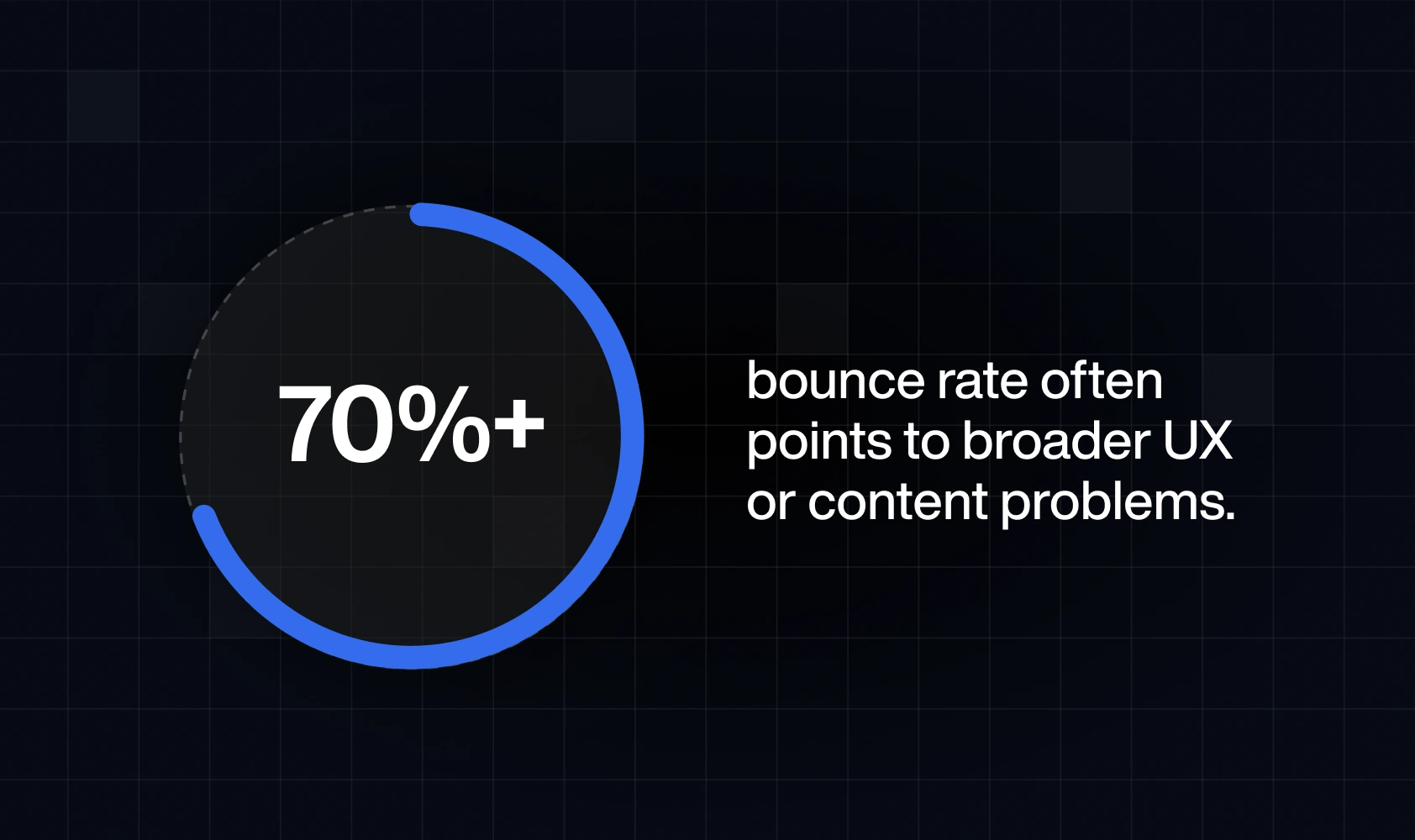
- Bounce rate increasing despite stable traffic - if people arrive but leave quickly, it clearly points out that your site is not communicating value the right way.
- Sales cycle length is increasing due to trust or clarity issues - when prospects need more calls or reassurance before converting, your website may not be building enough confidence upfront.
- Audience or ICP shift not reflected in messaging - if your target market has changed but your site hasn’t, you’re speaking to the wrong people.
- Heavy reliance on paid traffic to compensate for weak performance - your website should convert efficiently on its own, not leave ads to do all the heavy lifting.
- CMS limitations are slowing down launches or experiments - sometimes a more scalable approach, like Webflow implementation, would better support growth.
Designing for AI and modern discovery
We should all be aware that custom web solutions are no longer processed only by humans. It’s also interpreted by search engines and AI tools that help users find answers and compare options. Therefore, it shouldn’t come as a surprise that AI is changing the future of web and UX design.
If your site isn’t structured clearly, it’s not just harder for people to understand - it’s harder for AI systems to interpret. And if AI can’t understand it, you become less visible in modern discovery channels. It means you need to have:
- Clear hierarchy and semantic structure - your headings, sections, and content should follow a logical order.
- Consistent component usage - consistency creates clarity, for both AI and humans, while random layouts create confusion.
- Content designed around intent - AI systems now prioritize content that directly solves problems, so there’s no point in simply filling the sitemap with pages, like before.
At the same time, there are some other things that reduce how easily AI systems can interpret and surface your content, such as overuse of heavy animations that interfere with content rendering, text embedded inside images, or even disconnected messaging across pages.
You may notice this from your personal experience as well, but users rely more and more on summarized results and AI-generated comparisons. Therefore, AI-readiness isn’t one of those nice-to-haves. Today, it’s becoming a practical redesign trigger. If your site cannot clearly communicate its structure and purpose to machines, it limits how discoverable your business can be - and can severely impact your growth.
Expensive redesign mistakes businesses make
It’s not the quality of the redesign that will determine if it will be a success, but the UX design strategy behind it. In the following text, you can find some of the most common mistakes that turn a redesign into a waste of time and budget instead of a smart investment:
- Redesigning for aesthetics instead of outcomes - redesign goals are websites that convert (modern look can be just an added bonus).
- Copying competitors without understanding their strategy - since you may have a different positioning and audience, what works for another company may not work for yours.
- Ignoring data during decision-making - you should always base a redesign on performance metrics. Otherwise, old problems will keep repeating in a new layout.
- Treating redesign as a one-time project instead of a system - without ongoing optimization and testing, performance is bound to slowly decline again.
- Rebuilding without a clear measurement framework - there must be clear success measurements so you can determine whether the redesign actually worked.
A smarter approach to website redesign
Most people think a redesign starts with visuals (colors, layouts, inspiration, and the like). However, if you have a capable product design team guiding the process, a good redesign will always start by auditing the current site. It helps you keep what works and avoid repeating the same mistakes in a new design.
From there, every change you make should be driven by a certain business goal, so the structure and messaging of the site match it. At the same time, it’s important to consult real data to see what actually helps people take action.
And finally, a website isn’t something you finish once and never touch again. That’s why it’s important not to set perfection as your goal. Instead, you should focus on building a flexible system that’s easy to update.
How Devolfs approaches website redesign
A good redesign needs to be smart and built to perform. With many years of redesigning under our belt, we are well aware of that. That’s why we strategically approach each redesign project. Our team:
- Starts with real insights,
- Makes strategy, design, and development work together,
- Focuses on creating a strong foundation that can scale,
- Treats websites as evolving products,
- Creates user-focused structures.
If your website feels outdated or isn’t performing the way it should, it might be time to rethink it. Consider our website redesign process to see if it fits your vision. If so, don’t hesitate to reach out to us and book your demo.
FAQ
How often should you redesign your website for optimal performance?
Since your site needs to evolve alongside your product and user expectations, a redesign is recommended every 2 to 3 years.
When is it time to redesign your website instead of just updating it?
If you keep updating and fixing different elements constantly, but performance doesn’t improve, that usually means the problem is much deeper.
What metrics indicate that a website redesign is necessary?
Some of the metrics that can help you realize that it may be redesign time are: high bounce rates, low conversion rates (even with high traffic volume), and long sales cycles.
Is redesigning your website worth the investment for growing companies?
If growth is a priority, yes.
What’s the difference between a website refresh and a full redesign?
A refresh is made to improve visuals and light messaging. A redesign, on the other hand, deals with everything from positioning and structure to user flow and technical setup.
Can an outdated website hurt SEO and conversions?
Yes. Your rankings can be easily affected by slower load time and weak structure, but also by unclear messaging that impacts user (mis)trust.
How does AI search change when you should redesign your website?
AI tools prioritize clarity and structured content. Therefore, if your content is vague or poorly organized, you’re less likely to show up in AI-generated results. In that case, a redesign is needed.
What happens if you delay redesigning your website for too long?
You end up compensating elsewhere. It means you’ll have to set aside more money for paid ads and provide more sales effort - and it will continue to go on and on. In the end, the cost of compensating will outgrow the cost of redesign.


Read next


Let’s talk about what’s next.